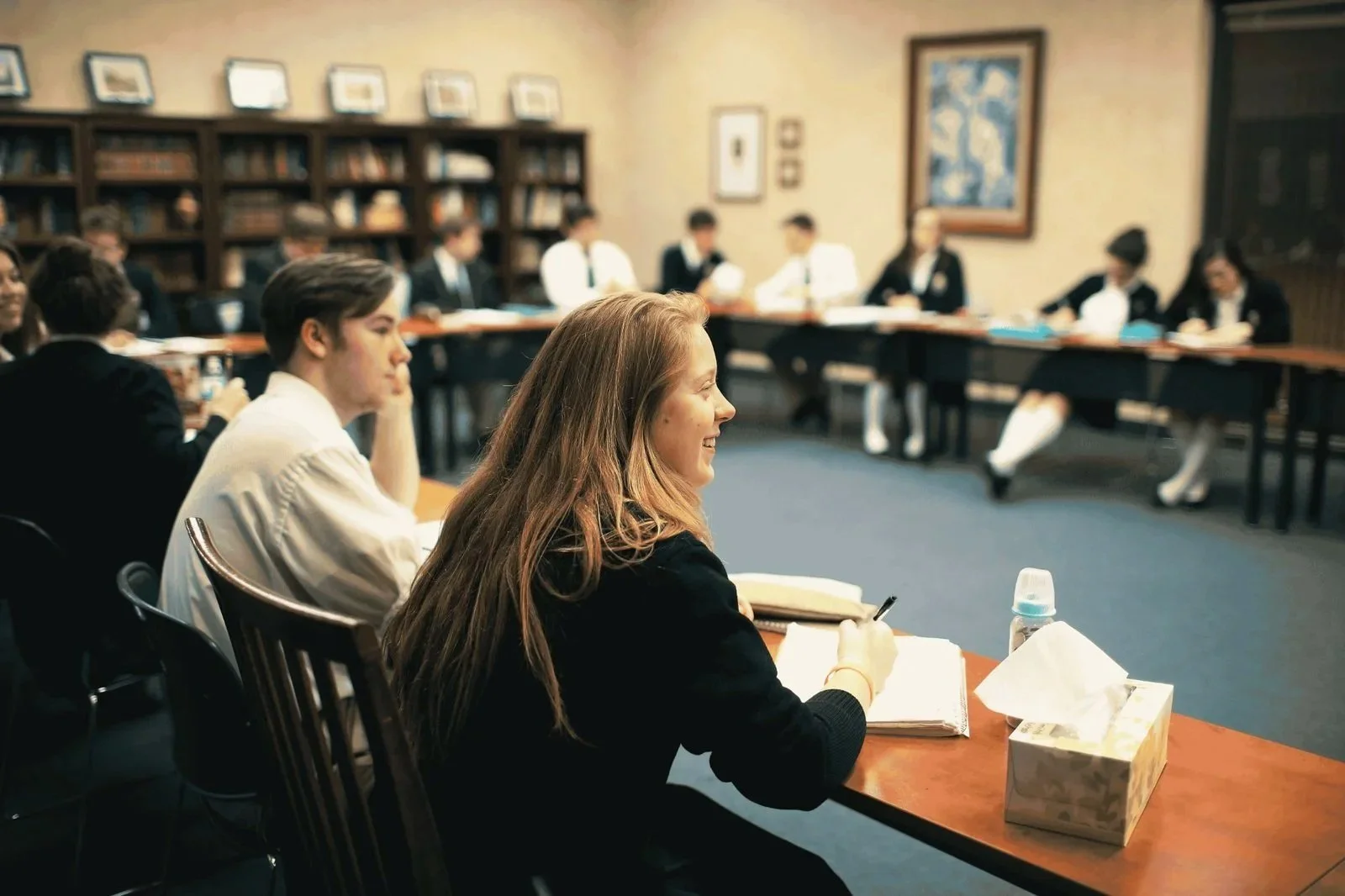
What is Classical Education?
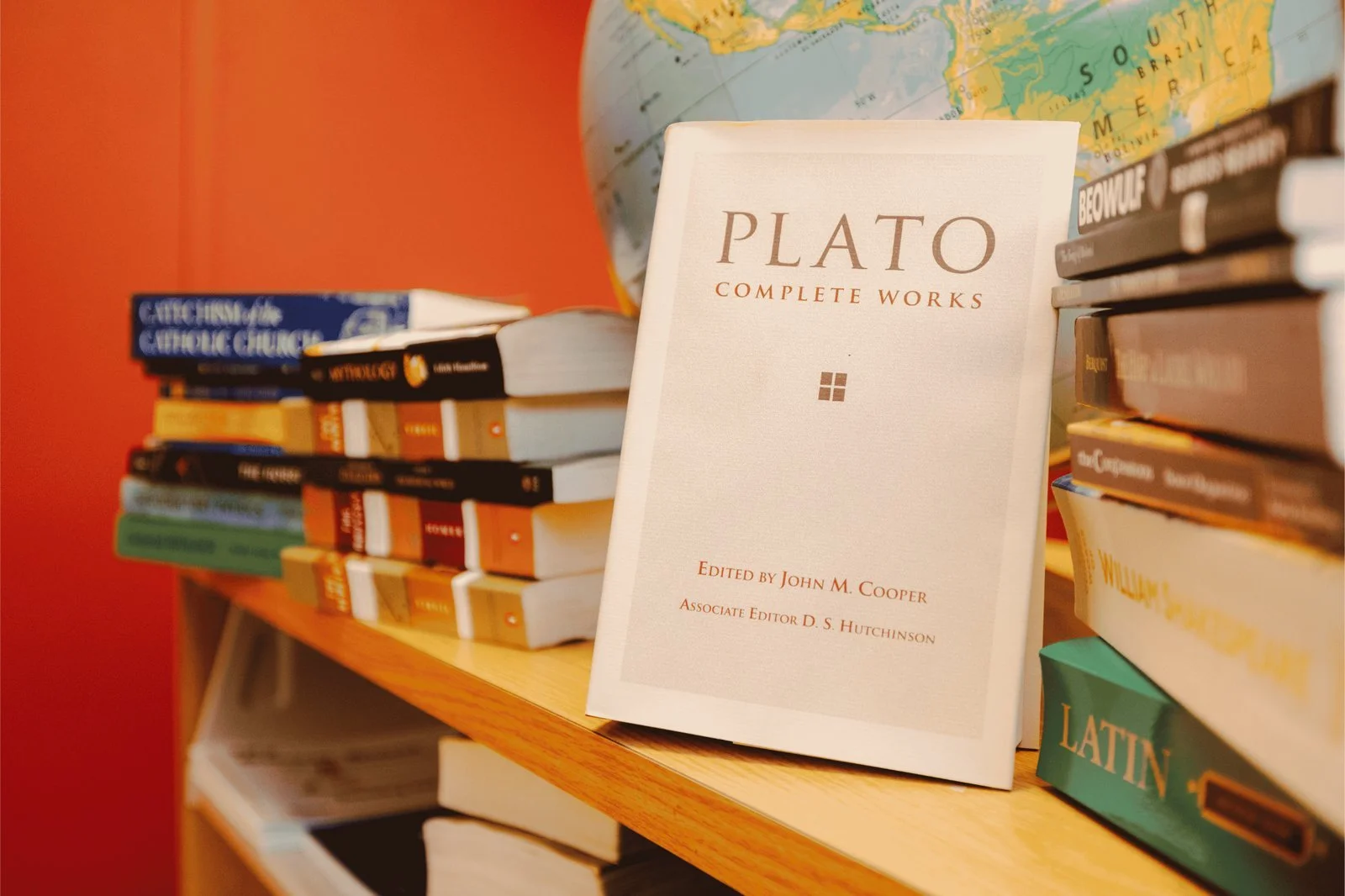
Classical Education
Attempts to define a classical education tend to fail in one of two ways; Rather than clarifying, they mystify matters further, (“A Classical Education is not about what to think, but how to think...”) or they substitute complexity for clarity (“Classical education, understood in its fullest historical, philosophical, and pedagogical dimensions, may be described as the integrative cultivation of the intellectual and moral faculties of the human person through the canon of received texts within the Western Tradition…” etc. etc.)
So, with some trepidation, knowing that greater minds than my own have made the attempt, I will try to split the difference and offer as practical and straightforward a description as I can muster.
You may have heard “Classical Education” referred to by other names: the Trivium, or a Great Books Education or The Socratic Method. Not long ago, however, it needed no special label at all. It was simply what people meant when they spoke of being educated.
Prior to the Industrial Revolution and the rise of our modern education system, an education in the Western world meant a grounding in the Classics—in the great works, ideas, and traditions that shaped our civilization. When we hear that a historical figure was “highly educated,” it almost always means that he or she was formed by this classical tradition.
This was the kind of education received by figures such as George Washington, Winston Churchill, William Shakespeare, Queen Elizabeth, and Emily Dickinson. Though they differed in time, place, and vocation, they shared a common intellectual inheritance—one that trained not only the mind, but the whole person.
Today, Classical Education is sometimes lauded as “an elite education, not an elitist one.” There is truth in this, but it can also be misleading. Historically, access to the classics was more often than not limited to the privileged. After all, if one were the beneficiary of such an education, it meant that your labor was not required on the farm; that you were not entering into an apprenticeship or indentured service; it meant you had enough surplus time and leisure to commit to study. Yet in our own time, even the most expensive, prestigious private schools – even an ivy league, college education – no longer guarantee any meaningful encounter with the great works of the Western tradition. A modern “elite” education may prepare students for careers in STEM, but it often neglects the deeper sources from which those disciplines arose. (And to be clear, a classical education has absolutely nothing against STEM; students study science and mathematics with just as much rigor as they do the humanities; these domains are simply less partitioned within the classical model.) Modern education may claim it will provide the tools for a student to master technology, but as more and more computers enter the classroom, we see it's often the technology that, in the end, masters the student.
A private education may open a path for a student to join the managerial class (our modern world’s aristocracy) and prepare them for a leadership role in business or government, but there is nothing that guarantees such an education will teach what leadership is for, or how to exercise it with wisdom and virtue.
Much of contemporary education is focused on what can be measured: test scores, rankings, and outcomes. While these have their place, they are not enough. Students are asked to master subjects and skills, but are seldom first given a reason why. They are encouraged to pursue success, but success is too often defined only in terms of wealth, status, or efficiency.
As the (Classically Educated) Philosopher Thomas Carlyle once wrote:
“...we have our ‘Statistics,’—our Science of the Condition of the People; which, if it were really a science, might be among the most important. But it is not by mere figures, and tabulations, and mechanical arrangements, that the condition of a people can be understood. Statistics is a science which ought to be honorable, as well as useful: the basis of many most important sciences; but it is not to be carried on by steam, nor without a wise head.”
In this environment, it is not surprising that many young people feel a sense of aimlessness and nihilism. The soul has been stripped from Western Education. When education is reduced to utility alone, something essential is lost. This has given rise to the bias that a sullen dissatisfaction is an inevitable aspect of any adolescence; a myth that Classical Education easily dispels. Teenagers are no longer taught about The True, The Good, and the Beautiful, and yet we marvel when they fail to exhibit any joy. Show me a teenager taught that the human person is not merely a producer or a consumer, that education is not merely job training, but the formation of the soul, and I will show you a joyful young adult.
Under the Classical model, students are introduced early and hear repeated often the Greek concept of telos - meaning “end” or “purpose”. That cliched definition, “a Classical Education is not about what to think, but how to think” is certainly true; cliches are cliches for a reason, and ‘how to think’, in-and-of-itself is certainly a rare and worthy gift in our current age, but I don’t think that it accounts for the difference in demeanor observed in its Classical Ed students. Their outlook is a result of not only being taught how to think, but toward what end. Students are invited to see their lives in teleological terms; as ordered toward meaning, responsibility, and ultimately, toward another Greek concept, ‘eudaimonia’, or ‘human flourishing.’
Classical Education begins from a different premise. It insists that students are not only capable of knowing truth, but are made for it. It introduces them to the enduring questions of human life: What is true? What is good? What is beautiful? What does it mean to live well?
These are not abstract or esoteric pursuits. They are deeply practical. A student who learns to recognize truth is less easily misled. A student who learns to love the good is better prepared to act with integrity. A student who learns to appreciate beauty becomes more fully alive to the world.
At its heart, Classical Education is an education in freedom—the freedom that comes from knowing what is worth loving, and why.
-Jesse Mayhew, Founding Chair of the Board of Directors
At Chesterton Academy of The Divine Mercy, we seek to recover this tradition. Not as a relic of the past, but as a living and vital way of forming young men and women for lives of purpose, faith, wisdom, and joy.
Frequently Asked Questions
-
This is, perhaps, the most common and most reasonable question.
In a world shaped by technology, specialization, and rapid change, it can seem impractical to spend time reading Homer or Shakespeare or St. Augustine. Surely, the argument goes, students would be better served by focusing narrowly on technical skills that translate directly into a job.
But this assumes something that is not quite true: that the modern workforce is made up primarily of specialists doing purely technical work. The modern economy does not simply run on code; it runs on people who can understand, organize, and communicate complex ideas across disciplines.
According to the World Economic Forum’s “Future of Jobs Report”, the most in-demand skills are not narrowly technical. They include:
Analytical thinking
Complex problem-solving
Critical thinking
Creativity and originality
Leadership and social influence
(Technical skills, notably, rank lower on the list and are often more easily automated or outsourced.)
These are not incidental skills in a classical education—they are its central aim.
A student trained in the Socratic method learns to listen carefully, speak clearly, and follow an argument wherever it leads. A student formed by history, philosophy, literature, and theology learns how to synthesize information, discern what matters, and make sound judgments.
This question also assumes something else that is not true: that liberal arts graduates (the collegiate approximation to a Classical Education) don’t succeed at the same rate as their more technically specialized peers.
The evidence suggests that they do.
A study by the Association of American Colleges & Universities (AAC&U) found that while liberal arts graduates may start with slightly lower salaries, they often catch up to and surpass their peers in earnings over time, especially in leadership roles.
Analysis from the U.S. Bureau of Labor Statistics shows that liberal arts graduates are employed across a wide range of fields, including business, education, law, and management—not confined to any single track.
It is also frequently noted that a significant percentage of CEOs hold degrees in the liberal arts. While exact figures vary by study, estimates often suggest that well over half of top executives do not have undergraduate degrees in business or technical fields, but in disciplines like history, philosophy, or literature.
Why might this be?
Because leadership is not primarily a technical problem. It is a human one.
One speaker at a recent Chesterton conference put it this way: his first employer hired him because of his Great Books background, not in spite of it—on the assumption that “if you can understand philosophy, you can understand business.”
That may sound surprising, until we consider what many jobs actually require.
To work in fields like business, marketing, management, or entrepreneurship, one must learn to:
understand complex systems
synthesize different kinds of information
communicate persuasively
exercise judgment amid uncertainty
lead conversations, not just follow instructions
These are not “extra” skills. They are the work itself.
As one job description from a leading communications firm put it, they are looking for someone who can: “uncover essential truths, make the complex simple, and make the invisible visible.”
That is a description of a classically educated mind.
The last, but perhaps the most consequential, presumption that this question implies is that the most technically-educated and specialized professionals have achieved their expertise only after having disavowed and abstained from any sort of great books education. That embracing a career in STEM requires a denigration of the Classics.
My evidence against this binary is perhaps more anecdotal, but I have seldom found this to be the case. Often the most technically-minded, successful professionals tend to also be the most well-read. If I see I book on coding on a bookshelf, books on philosophy and theology are almost always close by.
Earlier in my career, while employed at a software company, I still remember a conversation I had with the man in charge of our company's databases. In describing his job, he said to me “A database scheme is simply an ontology which defines the concepts a system is capable of thinking about.”
Ontology is a philosophical discipline that studies both what exists and what kinds of things exist. The term is a combination of two greek words; ‘ontos’ (being) and ‘logos’ (‘word’ or ‘discourse’) though the actual concept ‘ontology’ was not coined until the much later, German Scholastic tradition.
This man clearly knew his metaphysics. If this man had been alive in Ancient Rome, he would have built and designed aqueducts, if he had been alive in medieval Europe, he would have erected cathedrals; he happened to be a denizen of the 21st century, and so he became the designer of databases. The vocations have changed, but the curiosity and sharpness of mind have remained the same. Just like the architects and engineers of antiquity, his education had trained the whole person.
A classical education does not reject science, mathematics, or technology; it teaches them as part of a larger whole.
But it does resist the idea that education should be reduced to immediate utility.
A narrowly trained student may be well-prepared for a first job. But industries change. Technologies evolve. Entire fields appear and disappear within a decade. When a student is formed in how to think, how to learn, and how to discern, such a student is prepared not just for one career, but for many.
-
You may have heard the familiar answer: “A great book is one that has withstood the test of time.” Like many clichés, this contains a grain of truth but is, ultimately, an insufficient definition. Longevity alone cannot bear the full weight of what we mean by a “Great” book. It is not difficult to imagine a work of popular fiction like The Harry Potter Series remaining widely read a century from now. And yet, without intending any slight to Ms. Rowling, endurance in the marketplace is not quite the same thing as greatness in the classical sense. (We at Chesterton Academy of the Divine Mercy, for what it’s worth, have no quarrel with Harry Potter; indeed, we even have a house system; just like Hogwarts!)
A better definition is not tied merely to how long a book survives, but to the kind and depth of the influence it exerts. A great book is one that has become part of the very DNA of Western civilization. It is not simply read; it is inherited. It is one of the load-bearing beams in the structure of our common life. Remove it, and something essential collapses.
One might think of The Great Books as individual blocks in a great and precarious Jenga tower; none can be pulled out without bringing the whole structure down with them. These are the books that have shaped not only what we think, but the very way in which thinking is possible within our tradition.
Consider the relationship between the ancient world and the Christian intellectual tradition. Thinkers like Plato and Aristotle laid the philosophical groundwork by posing enduring questions about truth, being, justice, and the nature of reality. These ideas did not vanish with antiquity. They were taken up, refined, and in many ways transformed by figures such as Augustine of Hippo and Thomas Aquinas, who brought Greek philosophical insight into conversation with Christian revelation.
This synthesis, in turn, shaped the thinking of later, more modern figures such as John Locke and Thomas Hobbes, whose ideas continue to inform our understanding of political life, rights, law, and the structure of modern society.
What we call “great books,” then, are not isolated achievements. They are part of a living conversation, with each one responding to what came before and shaping what comes after. Their greatness lies not only in their internal brilliance, but in their indispensability to that ongoing dialogue.
It is often said that a Great Book does not tell us what to think, but how to think. But even this does not go far enough. Their influence operates at a deeper level still. They form the habits of mind, the categories, the assumptions through which we encounter the world.
If one could somehow remove these works from history, it is not merely that we would lose certain ideas; we would lose the very framework that allows those ideas to be conceived in the first place. Our intellectual “muscle memory”; the patterns by which we reason, question, and understand, would be fundamentally altered.
In this sense, their influence is almost invisible. Like the body’s most vital, automatic functions; the lungs breathing, the heart pumping blood, or the eyes blinking; they operate beneath the level of conscious awareness. We do not notice them precisely because they are so fundamental. It is only through encountering and studying these works directly that we begin to recognize the depth of their influence.
A “great book,” then, is not simply one that endures. It is one that forms. It shapes a civilization not from the outside, but from within. It does not merely survive history; it makes history what it is.
-
In a word, no.
Classical education is not the exclusive possession of the Catholic Church, nor is it confined to any single denomination or institution. There are many excellent classical schools founded and sustained by our Protestant brothers and sisters in Christ, and there are even secular institutions, such as the Great Hearts network of charter schools, that have embraced the classical model with seriousness and success. Likewise, not every school that bears the name “Catholic” offers a classical education. The two are not synonymous.
And yet, it would be difficult to tell the story of classical education without giving a central place to the Catholic tradition. Why this is so is rather obvious; the classical tradition is, after all, the western tradition, and for centuries, there was simply nobody else around in the West to do the job!
For much of Western history, the Catholic Church served as the primary steward of learning. The preservation of texts, the cultivation of philosophy and theology, and the transmission of what we now call the “Great Books” all took place, to a remarkable degree, within Catholic institutions. Monasteries, cathedral schools, and later universities did not merely safeguard this inheritance; they developed it, refined it, and handed it on.
This helps explain why classical education is so often found, even today, within Catholic communities. It is not because the method itself is exclusively Catholic, but because it is deeply at home within the Catholic intellectual and spiritual tradition.
One might draw a loose parallel to Montessori education: now widely practiced in secular settings, yet originally born from Thomistic Philosophy and nurtured and evolved within Catholic environments; a fact which very few people are aware of today.
There are also broader historical currents worth noting. The rise of modern, industrialized education coincided with the Industrial Revolution, which brought with it new social and economic demands. The world became more mercantile and less religious. Education, in many places, began to shift toward efficiency, standardization, and the formation of a workforce suited to industrial society. Some sociologists, notably Max Weber, have associated aspects of this development with Protestant cultural currents, particularly those emphasizing productivity and economic vocation. Without passing judgment, it is fair to observe that this shift often moved education away from its older, more contemplative and integrative aims.
By contrast, the classical tradition remained oriented toward the formation of the whole person; mind, body, and soul, and toward the pursuit of truth, goodness, and beauty as ends in themselves. These aims are not uniquely Catholic, but they are profoundly consonant with Catholic theology, which understands education as part of the larger task of forming the human person for both natural flourishing and supernatural destiny.
So while classical education is not exclusively Catholic, it is no accident that it has been so carefully preserved, and is now so vigorously renewed, within Catholic communities. The two are not identical but they are historically and philosophically deeply aligned.