Academics
Our Curriculum
Students at Chesterton Academy enjoy a cohesive, content-rich education. A broad exposure to many different disciplines helps students expand their interests and uncover hidden talents. Each year builds on the previous, so that by the end of senior year, our students are articulate, clear-thinking, well-rounded, and, very importantly, joyful individuals.

The Humanities Program
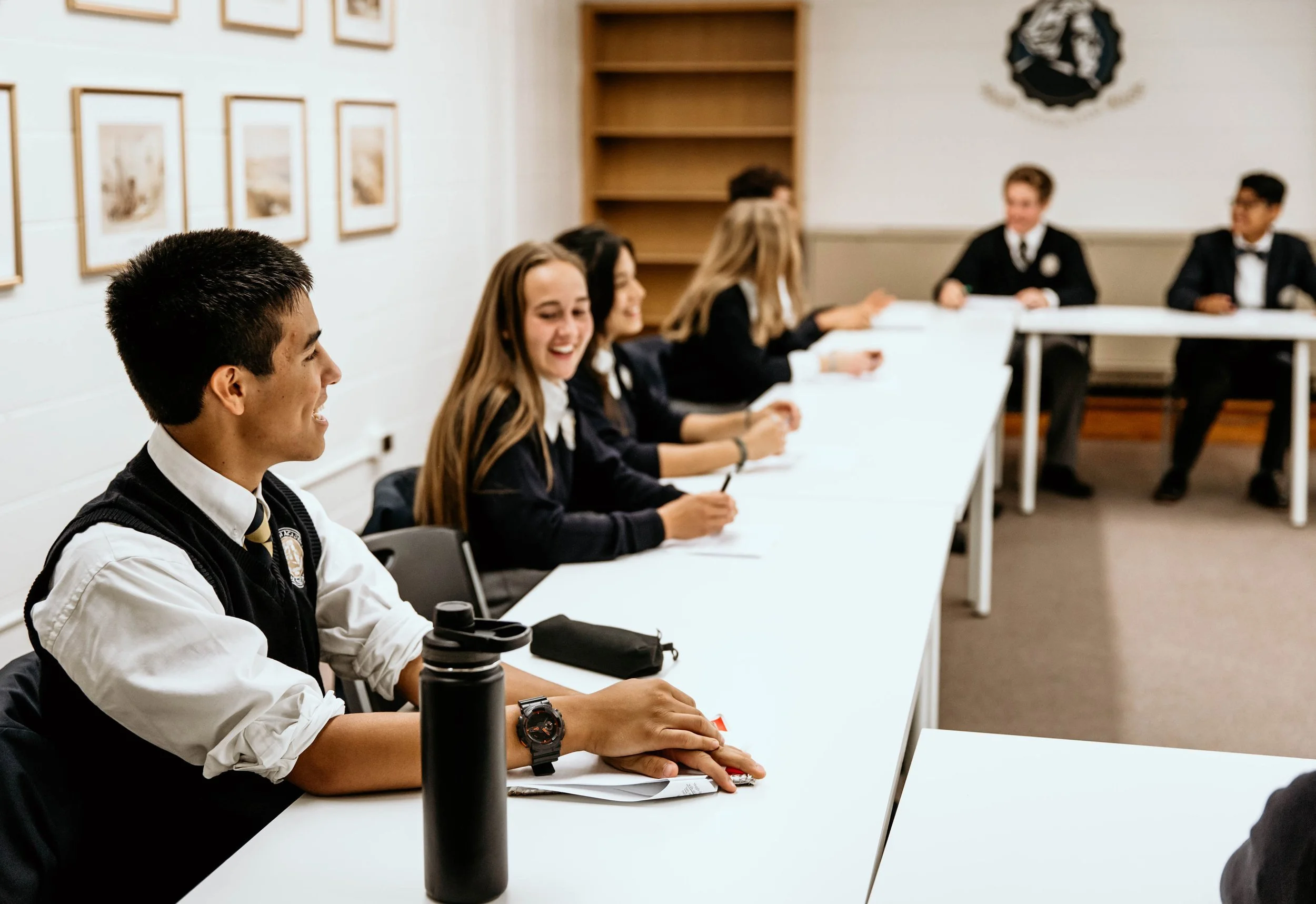
History, literature, philosophy, theology, and languages are braided together in an integrated curriculum utilizing the Socratic Method.
-
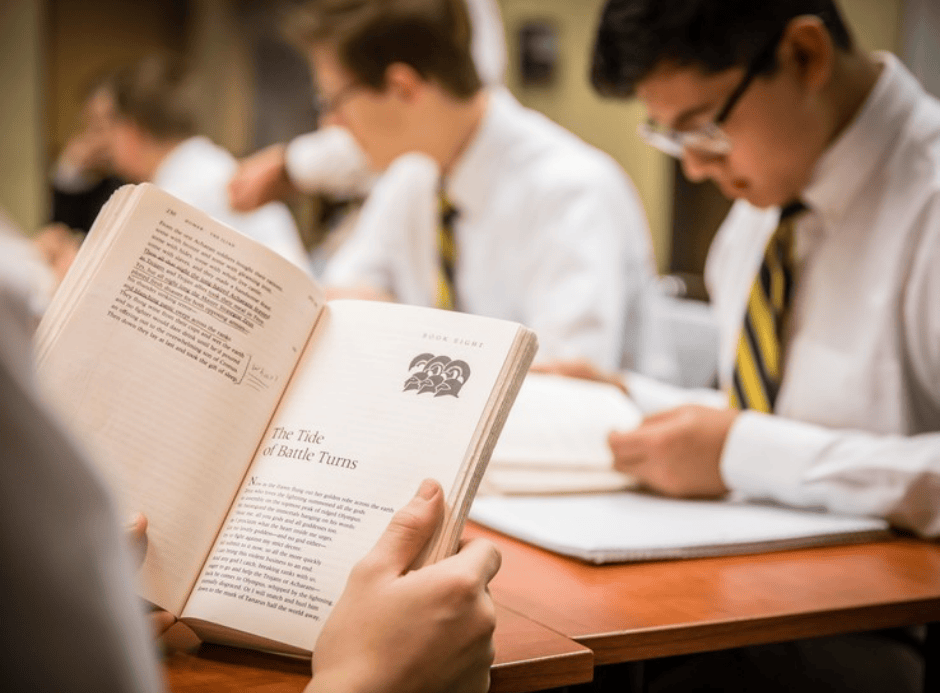
Our study of literature is tied to the study of history and the rest of the humanities. Students are first introduced to classical epics of Homer and then exposed to early English classics such as The Canterbury Tales and modern literary renderings of medieval history. Moving towards the modern period, they read Dante, Shakespeare, Dickens, Dostoevsky, Chesterton, and American literature. Reading and writing go hand in hand, and each student masters the art of the essay in their writing assignments in all subjects.
-
The history classes at Chesterton Academy form the backbone of our curriculum. The four-year history sequence covers ancient history through the Greek and Roman civilizations, early Church history, the Middle Ages, the Renaissance, and the Reformation and Counter-reformation. In senior year, students study the modern era, including the American and French Revolutions, the Industrial Revolution, the Communist Revolution, and the Sexual Revolution. Each history course is tailored to provide a colorful backdrop for literature, art, and science classes.
-
Philosophy, “the love of wisdom,” exercises the brain while it elevates the soul. The ability to understand abstract concepts leads to clear and systematic thinking in all things. We use philosophy to connect the humanities, but also to show its obvious connection to logic and mathematics. We study the development of philosophy from its classical roots focusing on Plato and Aristotle, its dramatic encounter with the early Church, its christening by St. Thomas Aquinas, and its deterioration in the modern era.
-
Theology, “the study of God,” is the context by which all other texts are studied. The principal theological texts studied are the Bible and the Catechism of the Catholic Church. We also read selections from the Church Fathers, Documents of the Church Councils, and Papal Encyclicals.
-
The study of a foreign language is required of all students for three years. All students are required to take three years of Latin and may take a fourth year. Because students may have already studied a foreign language before they arrive at the school we try, as much as possible, to place them in the correct level right from the start, regardless of their grade.
-
Grade 9: Ancient World
Grade 10: Early Medieval Period
Grade 11: High Middle Ages to the Renaissance
Grade 12: Modern World
The Math & Science Program
Math and science are intimately connected; the logic of math is seen in philosophy and God’s handiwork is seen in the sciences.
-
Mathematics is the art of measuring. Science is the study of what can be measured. While math is woven together with the sciences, it is also connected to the humanities. It teaches logic, which is a basic philosophical principle. It teaches balance, which is a basic aesthetic principle. Math at Chesterton Academy covers Euclidean geometry and algebra, all the way through advanced Calculus.
-
Foundations Track: Euclidean/Analytical Geometry - Algebra I - Algebra II/Trig - Pre-Calculus or Statistics
Traditional Track: Euclidean/Analytical Geometry - Algebra II/Trig - Pre-Calculus - Calculus or Statistics
C-STEM Track: Euclidean/Analytical Geometry - Pre-Calculus - Calculus (AP Calc AB) - Calculus (AP Calc BC)
-
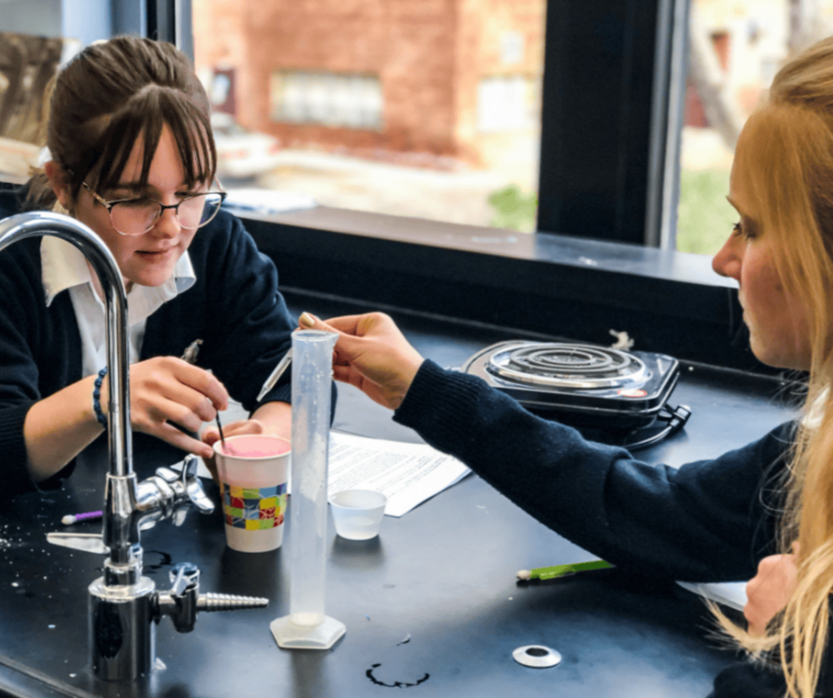
Science is the study of the physical world, that is, of God’s creation. None of these subjects can be approached without a sense of wonder. It is fitting, therefore, to begin by looking up at the heavens, at the lights in the sky: Astronomy. Then we take a look at the world God created (Geology), the creatures he created (Biology), and the intricate substances of which all things are made (Chemistry). We end by gaining an understanding of the nature and properties of matter and energy (Physics).
-
Grade 9: Astronomy and Earth Sciences
Grade 10: Biology
Grade 11: Chemistry
Grade 12: Physics
The Fine Arts
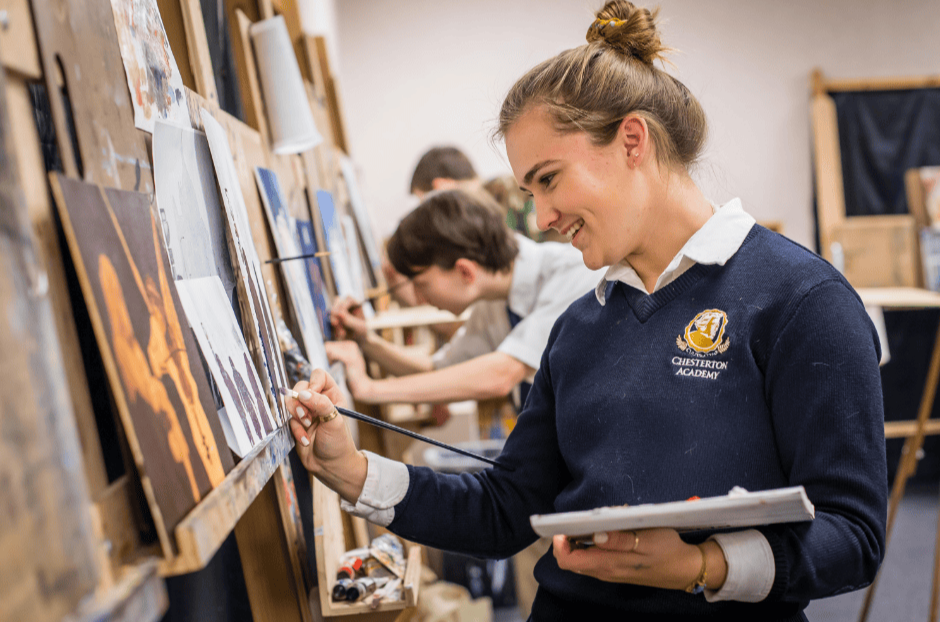
Equal emphasis is given to the arts, so that every student learns to draw and paint, sing in the choir, act on stage, give speeches, and engage in debate.
-
Music appeals to the ear and the mind, the emotions and the intellect, the senses and the spirit. Chesterton Academy students are exposed to a wide variety of music that they perform chorally several times a year. An education at Chesterton includes music theory, performance, ear training, note reading, and musical analysis. Music history is taught according to the grade level with an emphasis on music development within the Church, and corresponds to the historical period in which the students are immersed. Students perform in grade-level choirs and in the all-school choir at choir concerts and Masses.
-
A complete education must include the development of the creative nature and must provide students with the tools and the technique with which to express their ideas, their feelings and their love. It must also include the analytical skills with which to judge a work of art and exposure to great art. Finally, the mechanical skills and the aesthetic aptitude must be put into the proper context of eternal Truth. A good artist is a complete thinker and vice versa. The influence of the arts in today’s society cannot be overstated, and this is why art is mandatory at Chesterton Academy all four years.
-
Grade 9: Ancient Art History | Drawing and Calligraphy
Grade 10: Late Roman and Early European Art History | Pastels and Colors
Grade 11: Late Gothic, Renaissance, and Baroque Art History | Oils
Grade 12: Classical, Romantic, and Modern Art History | Oils
-
The dramatic arts are particularly powerful in our present culture where movies and the media are often the primary source of knowledge and ideas for many young people. Drama involves the study of how words are brought to life, and in order to successfully do this on stage the actor must learn to see the work as a whole, to understand the author’s vision and the time in which it was written. In other words, the actor must learn to be a good literary critic, philosopher, and historian. Drama ties together the information students learn in the classroom and asks them to actively participate in its performance.
-
Grade 10: Comedy
Grade 11: Drama
Grade 12: Shakespeare
House System
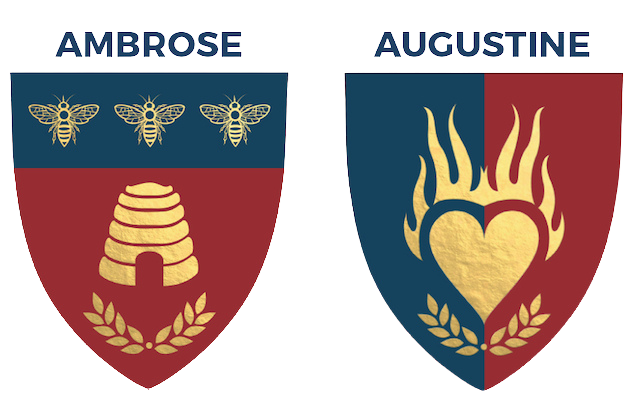
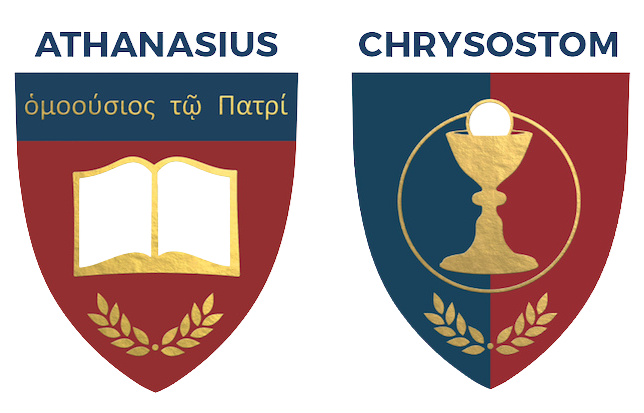
Chesterton Academy’s House system is drawn from the 1,000 year-old tradition of Christian education exemplified in the colleges at Oxford and Cambridge. The Houses provide real, tangible community within the larger school, giving students the opportunity to take ownership, fulfill the call to leadership, and to cultivate the ideal conditions for virtue. Each House has two Senior and two Junior prefects, two faculty advisors, and several parent liaisons.
Our College Partnerships
Our partnerships with Catholic colleges give Chesterton students the chance to earn real college credit while still in high school. These courses build on the strength of our classical curriculum, forming both the mind and the heart. Families benefit from meaningful savings, and students gain an early taste of higher education!
-
Receive College Credit—Partnership Courses: Juniors and seniors can receive college credit through the Franciscan Advantage Program. These courses are taught in the student’s own classrooms by their high school teachers so that students earn high school and college credit.
-
$8,000 Scholarship: Chesterton Academy graduates who are accepted to Ave Maria’s undergraduate programs will receive an $8,000 Chesterton Scholarship ($2,000/year for four years).
Summer Leadership Program: Rising juniors and seniors at Chesterton Academies are encouraged to apply for the Summer Leadership Program. Rising seniors have the opportunity to apply for admission, interview, gain acceptance, and receive initial scholarship awards.
The Institute: Chesterton Academy students are encouraged to consider applying for and participating in Ave Maria’s newly-launched Institute for Innovation and Industry.
-
$16,000 Scholarship: Offers a four-year $4000/year renewable ($16,000 total) scholarship to Chesterton graduates.
Offers 50% off the Best Week Ever for Chesterton students
-
$15,000 Scholarship: As a Classical Catholic School, Chesterton students qualify to apply for the Catholic Renewal Scholarship at Thomas More College of Liberal Arts. This scholarship is valued at $15,000 per year. It is renewable for up to four years, provided the student maintains a CGPA of 3.5 or higher throughout their time at the College and also meets one of the test score requirements listed on the Thomas More College website.
-
Credit Transfers: Accepts transfer of Franciscan Advantage course credits for specific Chesterton curriculum courses.
BCYC Immersion: Offers discounts for students to attend the Benedictine College Youth Conference (BCYC) Immersion.