

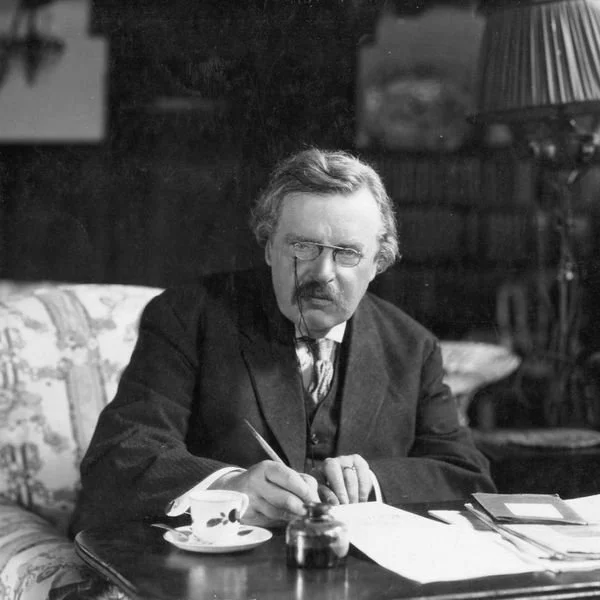
Get to know G.K. Chesterton
Who was G.K. Chesterton?
Gilbert Keith Chesterton was one of the most important intellectuals of the 20th Century - a prolific English author of books, poems, plays and over six thousand essays (yes, you read that correctly), who wrote about everything and did so with great wit, and insight. The English novelist, Evellyn Waugh, writing on Chesterton’s style, remarked that “He could make the English language do anything he wanted—turn somersaults and stand on its head… He could make it crawl on all fours.” People bought newspapers just to read his columns and radios just to hear his voice.
Immensely quotable (“To have a right to do a thing is not at all the same as to be right in doing it”) and immensely immense (300 pounds and 6 ft 4 inches tall!), he was large in every sense. He stirred the literary world, at times with his paradoxes (“A thing worth doing is worth doing badly”), his puns (“The world will never starve for want of wonders, but only for want of wonder”), and at times with both at once (“Angels fly because they take themselves lightly”).
Although he was not yet a Catholic at the time, he created one of the most beloved and well-known characters in detective fiction who happened to be a Catholic priest: Father Brown.
He wrote one of the last great epic poems in the English language: The Ballad of the White Horse. The poem tells the story of Alfred the Great and his struggle against the invading Danes (Vikings) in early medieval England.
With his friend and collaborator, Hilaire Belloc, Chesterton developed Distributism; a social and economic philosophy that offered an alternative to both capitalism and socialism.
His book on Saint Thomas Aquinas is still regarded as one of the greatest introductions and defenses of Aquinas’ thought to this day.
He debated some of the leading intellectuals of his day: George Bernard Shaw, Bertrand Russell, H.G. Wells, and Clarence Darrow. Chesterton had a remarkable reputation for personal warmth and generosity, and many of the people who disagreed with him most sharply still liked him and admired him. His friendships extended across serious ideological divides. Even when arguments were sharp, Chesterton tended to treat opponents as partners in a shared intellectual enterprise, not enemies.
He conducted two extended speaking tours of the United States. Every one of his lectures was front page news and attracted massive audiences. He had the same success in Spain, Italy, Ireland, the Netherlands, Poland and the Holy Land.
Chesterton shocked his contemporaries in 1922 when he was received into the Catholic Church. His conversion was world-wide news. In some people’s minds he went from being a writer to being a Catholic writer. Though he had always pointed to God (“The Christian ideal has not been tried and found wanting. It has been found difficult and left untried”), he was now pointing to Rome.
After his death, he naturally disappeared from the newspapers, and soon disappeared from the classroom, where his books were once taught. The world became a darker place after World War II, and Chesterton’s message of hope and joy was not what a jaded and despairing world wanted to hear. His battle against fads and fashions gave way to... fads and fashions. His writing, which dealt with the big questions, fell out of favor in a climate that wanted to deal with the small questions.
After two generations grew up with no exposure to Chesterton, a new generation began to rediscover him. They found him to be prophetic (“The next great heresy is going to be simply an attack on morality: and especially on sexual morality”), timely (“Men do not differ much about what things they will call evils; they differ enormously about what evils they will call excusable”) and profound (“The most ignorant of humanity know by the very look of earth that they have forgotten heaven.”) and to speak the truth plainly (“Right is right, even if nobody does it. Wrong is wrong, even if everybody is wrong about it”) but also poignantly (“When people begin to ignore human dignity, it will not be long before they begin to ignore human rights”) and with great humor. (“It is the test of a good religion whether you can joke about it”)